Coffee Farming Facts

The birthplace of coffee

How coffee farming works in Uganda

Coffee is Uganda's most important cash crop and its top export earner since the 1980s. In 2020 Uganda became Africa's largest coffee exporter — built almost entirely on the work of an estimated 1.7 million small-plot farmers across 108 districts.

Two species thrive here: Robusta, indigenous to Uganda and still growing wild in its rainforests, at altitudes of roughly 900–1,500m; and Arabica, introduced in the early 1900s, grown at 1,300–2,300m in the highlands of the east, southwest and northwest. The altitude, volcanic soils and farming systems give Ugandan coffee qualities that can't easily be found elsewhere.

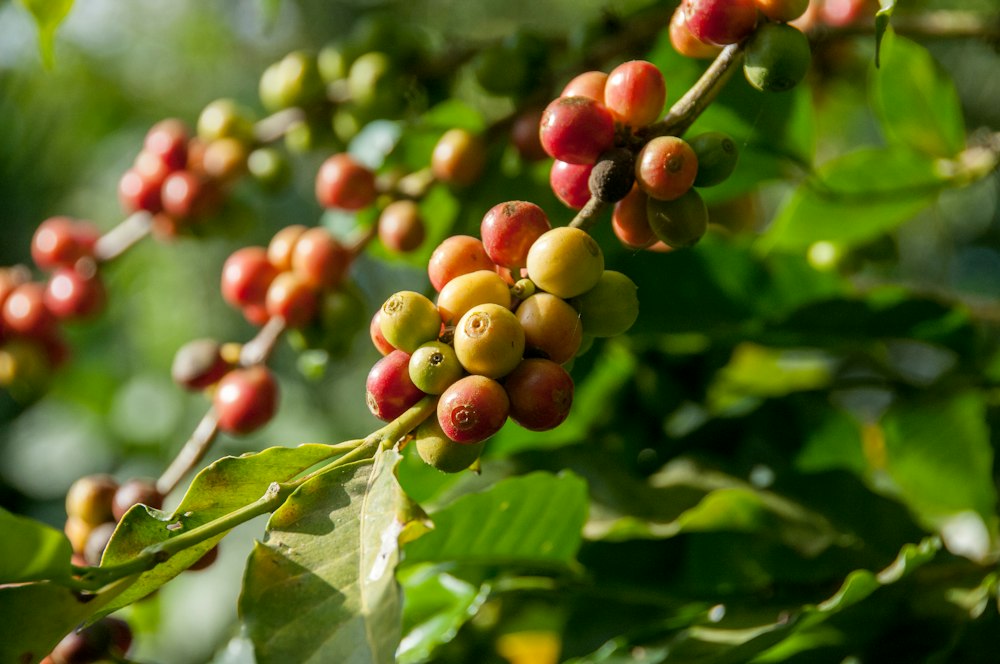
Coffee cherries ripening on the branch
1.7Msmallholder coffee farmers
108districts growing coffee
~4:1Robusta to Arabica ratio
#1African coffee exporter, 2020

Two species

Robusta & Arabica, side by side

Coffea canephora

Robusta

Indigenous to Uganda — wild Robusta still grows in the country's rainforests, one of the few places on earth with naturally occurring coffee trees. Grown mainly in the Lake Victoria Basin and central plateau, it's bold, bitter and low in acidity.

  • Altitudes of 900–1,500 m.a.s.l.
  • Nganda & Erecta varieties; high-yield clonal replanting
  • Mostly sun-dried; prized for espresso & instant coffee
  • Resilient to wilt and leaf-rust disease
Coffea arabica

Arabica

Introduced at the start of the 1900s, Arabica prefers shade, humidity and cool 15–24°C temperatures on highland hillsides. Berries ripen unevenly, so the best lots are selectively hand-picked at deep-red cherry stage.

  • Altitudes of 1,300–2,300 m.a.s.l.
  • SL 28, SL 14, KP 423 & traditional Nyasaland varieties
  • Sweet, mild cup — washed & natural processes
  • Sold to specialty markets at high premiums

Origins

Uganda's three Arabica regions

Southwest · 1,500–2,300m

Rwenzori Mountains

The "Mountains of the Moon" on the DRC border. Nitrogen-rich volcanic soil produces the coffees marketed as Wugar (washed) and Drugar (dry-processed) — mostly natural-processed, grown on small village plots.

East · up to 2,600m

Mount Elgon & Bugisu

East Africa's oldest volcano, home of the famous Bugisu — fruity, wine-like coffees with notes of raisin and fig from the Kapchorwa and Gibuzali washing stations. Harvest runs June–February.

Northwest · 1,300–1,600m

West Nile

Multi-generational farms shaded by indigenous banyan trees. Typically washed-processed and known for clean, citrus-driven profiles.

Signature origin

Bugisu — the cupper's favourite

From the slopes of Mount Elgon in Kapchorwa district, named after the indigenous Bugisu people and the Sipi Falls project (est. 1999) that strengthened quality and farmer incomes in the region.

Tasting notes

A clean, smooth, fuller-bodied cup — darker-toned and chocolatey. Excellent as a single-origin drinker or a blend base.

Roasting notes

Easy to roast from medium to dark. Medium roasts are delicate and sweet; dark roasts go strong, thick and smoky — a super-clean Sumatra style.

Two harvests

Most of Uganda enjoys two crop cycles — April to June and October to February — keeping fresh coffee flowing year-round.

Shade-grown

Small farms, often under half a hectare, intercrop for shade — cooler temperatures, healthier plants, more complex cups.

Sip the Pearl of Africa

Ready to talk coffee?

Ask for samples, pricing or private-label options — our export team replies within one business day.

Contact Us